
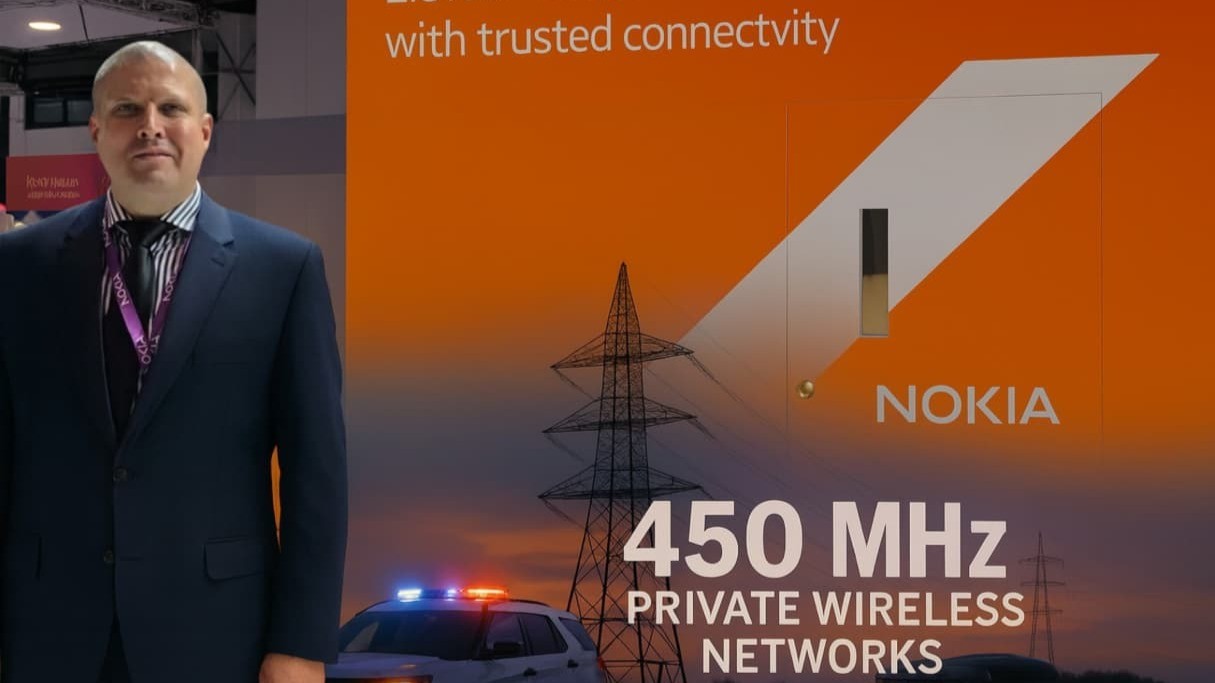
Keep the Country Online: Why 450 MHz Private Wireless should be a National Priority?

Moez BEN NEJMA
A wake-up call from the Iberian Peninsula
On April 28, 2025, the Iberian Peninsula went dark. Within seconds, Spain and Portugal lost electricity across the continent. Hospitals switched to backup power and traffic froze. Telecom networks began to fail as batteries drained and optical amplifiers lost power. Internet traffic fell to about 17 percent of normal levels.
For several hours, citizens and emergency services relied on satellite phones and ad hoc radio links to coordinate across cities that had fallen silent. Power was restored by evening through close coordination with France and Portugal, yet the event left a clear warning: when the grid fails, connectivity fails with it.
The blackout revealed a systemic vulnerability. Nations depend on networks that, in turn, depend on the same power infrastructure they are supposed to protect. To break that dependency, countries need a secure, sovereign and independent communications layer that stays online when public networks go silent. That is where the 450 MHz spectrum enters the picture – not as another mobile band, but as the foundation for resilience.
Why 410 – 450 MHz matter for national resilience?
The 410 – 450 MHz bands offer long reach and deep penetration. A single radio site can cover vast rural areas and reach into buildings, tunnels, and underground facilities. This makes it ideal for connecting millions of devices that keep a nation running, including smart meters, grid sensors, pumping stations, railway signals, and field-force radios.
The 410 to 450 MHz range is the low-frequency backbone of private wireless. Its propagation allows a small number of sites to provide national coverage and to penetrate deeply into dense or underground infrastructure. Internationally standardised through 3GPP Bands 87 and 88 for 410 to 430 MHz and Bands 31 and 72 for 450 MHz, it supports channel sizes of 2×1.4 MHz, 2×3 MHz and 2×5 MHz. These modest allocations are sufficient for mission-critical use cases such as push-to-talk voice, group video, telemetry, smart metering and industrial automation.
The technology ecosystem is mature and evolving. LTE 450 has been commercially deployed for over a decade, with hundreds of compatible devices from rugged smartphones to IoT modules. Recent 3GPP releases extend this foundation to 5G New Radio, introducing Reduced-Capability devices and network slicing to handle large fleets of sensors alongside secure voice and video. Operators can deploy LTE now and migrate smoothly to 5G later without replacing existing radio sites.
Just as importantly, 410 to 450 MHz networks deliver resilience by design. Because far fewer sites are required than in higher bands, each base station can be hardened with long-life batteries, backup generators, and dual backhaul. The narrow channels naturally steer operators toward availability, security, and sovereignty rather than raw throughput. Towers located on secure utility property can blanket entire regions, making it technically and economically feasible to protect every site and to build in redundancy.
Unlike commercial consumer bands, 450 MHz is often reserved for private or government-directed networks. This gives nations sovereignty over critical data and allows them to build independent, hardened infrastructure specifically designed for essential services.
Germany led the way. In March 2021, the Federal Network Agency (BNetzA) awarded a nationwide 450 MHz licence to 450connect GmbH for critical infrastructure, with usage rights running until 2040. The licence was reserved for energy and water utilities and other essential service providers. A year later, in February 2022, 450connect selected Nokia as its technology partner to deploy and operate the LTE450 network.
The project will use around 1,500 to 1,600 base stations equipped with backup power and secure management. Once fully operational, it will connect more than 30 million smart meters and thousands of utility assets – forming the backbone for smart-grid automation, SCADA and emergency operations across Germany.
450connect’s mandate goes beyond coverage. It is designed for 99.99 percent availability, operating independently from public carriers and capable of staying online during blackouts. In partnership with Nokia, it is becoming one of the world’s largest private broadband networks for critical infrastructure – a model that many countries are now looking to replicate.
Saudi Arabia followed a similar path, though with an industrial focus. In 2024, the Communications, Space and Technology Commission (CST) licensed 450 MHz to Aramco Digital to build a mission-critical network for energy, transport and other mission-critical sectors. Operating fully independently from public carriers, the Aramco Digital network will cover over fifty industrial zones across the Kingdom and deliver secure connectivity for Industry 4.0 applications such as automation, remote inspection and AI-driven analytics.
From an engineering standpoint, the economics are clear. To cover the same area, a network at 800 MHz needs about 2-3 times more sites than 450 MHz. At 2.3 GHz, it requires around twelve times more; at 3.5 GHz, nearly twenty times (Exact multipliers vary by terrain, clutter, antenna height, power class and indoor obligations).
Fewer sites mean lower capital and operating costs, simpler maintenance and fewer potential points of failure.
For nationwide resilience, 450 MHz combines coverage, security and affordability like no other band.
Who is leading the way?
Countries across Europe and the Middle East are already building private 410 – 450 MHz networks. Their experiences highlight a shared strategic vision.
- Germany – 450connect. The regulator reserved 450 MHz for critical infrastructure and awarded a 20-year licence to a consortium owned by utilities such as E.ON and Alliander. The nationwide LTE network, with 1,000 to 2,000 sites, will connect more than 30 million smart meters and form a secure backbone for Germany’s energy transition.
- Saudi Arabia – Aramco Digital. A national licence for 450 MHz is enabling an independent, mission-critical network for energy, industry and transport. Covering more than fifty industrial zones, it provides AI-driven applications and digital automation for Industry 4.0.
- Poland – PGE Systemy. The utility PGE is building a nationwide LTE450 network aligned with Poland’s energy strategy and the Ministry of Energy. It supports real-time grid monitoring, automated switching and smart pricing, as well as voice, video and augmented reality for field crews.
- Bahrain – Electricity and Water Authority. In 2021, EWA selected Nokia to deploy a secure private LTE network on 410 MHz (Band 87) to digitise its distribution grid. The first phase connects 500 secondary substations and six primary ones, with thousands more to follow.
- Ireland – ESB Networks. ComReg awarded ESB spectrum in the 410-414 MHz and 420-424 MHz bands for 15 years to digitalise the national grid. ESB contracted Sigma Wireless and Nokia to build a private LTE network as part of its “Networks for Net Zero” strategy.
- Finland – Ukkoverkot and Finavia. Finnish operator Ukkoverkot runs a nationwide private LTE network on 450 MHz and 2.6 GHz. A Nokia upgrade introduced LTE450 for industrial IoT and public safety. The first deployment at Helsinki Airport supports airside safety and logistics.
- Austria – Energie AG and Westermo. Energie AG is modernising 6,000 substations from CDMA450 to LTE450. The band delivers stable coverage across mountains and plains, ensuring consistent connectivity for grid communications.
The common thread is clear:
- Trusted partnerships between regulators and critical operators.
- Dedicated low-band spectrum reserved for national use.
- Prioritisation of reliability, coverage and security over consumer speeds.
- A smooth migration path from LTE to 5G.
Together, these deployments prove that 410-450 MHz is a practical and scalable foundation for digital transformation and national sovereignty.
Modernising mission-critical communications
Public-safety agencies and utilities still rely on legacy voice systems like TETRA or P25. These are dependable for voice but cannot carry the data, images and video needed in modern operations. The 380-450 MHz range has evolved beyond those limitations.
More than thirty countries now operate LTE networks in these bands and 5G support is already defined in recent 3GPP releases. New reduced-capability (RedCap) 5G devices are emerging, allowing seamless evolution from LTE without a full rebuild of towers or sites.
While the channels are narrow – typically 2×5 MHz or less – the goal is not speed but availability, coverage and security. Networks in this band favour hardened sites with batteries or generators, dual backhaul and local cores capable of “island mode.” These features provide resilience by design – the kind of resilience that keeps nations connected when everything else fails.
How to Monetise Limited Spectrum
Principle. The 410 to 450 MHz band gives you only two paired 5 MHz channels. Success does not come from chasing consumer throughput. It comes from selling reliability, coverage, and specialised mission-critical services at a sustainable cost. The model is simple: charge for outcomes, not megabits.
Monetisation pillars
- Tiered critical services, priced by user, device, or site.
- Availability as a product, with SLAs that command a premium.
- Managed solutions, bundling devices, apps, and support.
- Event and surge capacity, offered on demand.
- Edge and analytics add-ons, where data creates operational value.
Below are concrete examples by sector.
Public Safety and Emergency Management
What to sell?
- Mission-critical packages that include encrypted push-to-talk, group video, location services, and rugged devices.
- Priority and pre-emption, with auditable SLAs for uptime and latency.
- On-demand deployables with satellite backhaul for incidents and disasters.
- Drone-as-a-service for live aerial video and situational analytics.
How to price?
- Per user, per month for core services and priority access.
- Per incident or per day for deployables and temporary coverage.
- Per drone flight hour or per surveillance zone for aerial services.
Credibility anchors
- Citymesh’s national drone network in Belgium and Swisscom’s in Switzerland prove the model for aerial situational awareness.
- T-Mobile’s T-Priority shows how operators can commercialise priority service and network slicing.
Why it works with 410 to 450 MHz?
- Coverage first, bandwidth second. The band’s propagation ensures radios work where they must, including indoors, in tunnels, and across rural terrain.
Utilities and Smart Grids
What to sell?
- Smart-meter connectivity priced per meter, per year, with secure onboarding and remote firmware updates.
- Premium control channels for low-latency SCADA and protection signaling.
- Resilience kits that bundle portable base stations, edge computing, and secure workforce apps for blackouts and storms.
How to price?
- Per meter, per year for AMI connectivity at scale.
- Per substation or per feeder for control-grade links with stricter SLAs.
- Per kit, per month for resilience bundles, including readiness retainers and activation fees.
Credibility anchor
- Germany’s 450connect aims to connect around 30 million smart meters, illustrating national-scale economics on LTE 450.
Why it works with 410 to 450 MHz
- Narrow channels and low noise floors provide clean signals for sensors, with massive reach that lowers site count and OPEX.
Industrial Campuses, Oil and Gas & Mining
What to sell?
- A plant kit that includes a private LTE or 5G slice, worker wearables, IoT sensors, remote operations for machinery, and push-to-video for safety.
- Edge analytics and predictive maintenance as optional add-ons.
How to price?
- Per site for the slice and coverage envelope.
- Per device for wearables and sensors, with tiered QoS.
- Per analytic model or per asset for predictive maintenance and digital twins.
Why it works with 410 to 450 MHz?
- The focus is reliability and control rather than HD streaming. You get deterministic coverage over large, remote footprints with minimal infrastructure.
Transport and Smart Mobility
What to sell?
- Neutral-host airside and port operations that are isolated from public networks and tailored to safety-of-life needs.
- Rail communications for train operations, trackside sensors, and video.
- Event-based slices for seasonal peaks, congestion relief, or major sports events.
How to price?
- Per gate, stand, or berth for airports and ports.
- Per line-kilometre for railway corridors and tunnels.
- Per event window for temporary capacity and priority traffic.
Credibility anchors
- Dedicated operational networks at airports in Belgium show that neutral-host, mission-critical connectivity can be sold as a managed service.
Why it works with 410 to 450 MHz?
- Consistent coverage across long linear assets and inside tunnels with fewer sites and simpler maintenance.
Safe Cities & Rural Inclusion
What to sell?
- Managed sensor for cities: environmental monitoring and smart lighting with secure data hosting.
- Universal coverage bundles for rural clinics, schools, logistics depots and water infrastructure, including backup power and satellite backhaul options.
How to price?
- Per square kilometre of guaranteed coverage and SLA.
- Per sensor for device connectivity and maintenance.
- Per site for sovereign data hosting and retention.
Why it works with 410 to 450 MHz?
- One site covers large rural footprints. Keeping data local supports sovereignty and compliance.
Cross-Sector Upsell Playbook
- Availability SLAs. Sell 99.9, 99.99, or higher availability tiers with clear remedies.
- Security and sovereignty. Premiums for on-prem cores, lawful intercept, and compliance reporting.
- Edge compute. Charge for low-latency apps at the substation, plant, or station.
- Device lifecycle. Bundle rugged devices, warranty, spares, MDM, and secure provisioning.
- Integration. Paid integrations to SCADA, GIS, command-and-control, and video management systems.
- Analytics. Offer dashboards and KPIs: outage minutes avoided, incident response time, leak detection rate, worker safety indicators.
How to make the unit economics work
- Price by outcome, not by gigabyte. Tie fees to meters connected, substations controlled, gates covered, or incidents supported.
- Exploit coverage economics. The band’s long reach means fewer sites. Use the savings to harden each site and to fund SLAs that competitors cannot match.
- Use narrowband modes. NB-IoT and LTE-M on 410 MHz or 450 MHz make massive IoT profitable with long battery life and low device cost.
- Design for resilience. Sell backup power, dual backhaul, and deployables as line items. Customers will pay for continuity.
- Start with LTE, migrate to 5G. Keep radios and add 5G cores or carriers when RedCap devices are ready. No rip-and-replace.
With only two paired 5 MHz channels, your advantage is not bandwidth. It is trust. Package coverage, uptime, and sovereignty as products, then price them by user, device, site, or outcome. The result is a defensible, high-margin portfolio that serves public safety, utilities, industry, transport, and cities, all while keeping national infrastructure resilient and secure.
A gap exposed: Spain 2025
The Iberian blackout exposed how vulnerable national communications can be when they depend on the same grid that collapses. Internet traffic dropped to a fraction of normal levels and mobile sites quickly ran out of battery power. Emergency services struggled to coordinate black-start procedures, while citizens could not reach call centres.
A dedicated nationwide 450 MHz network would have changed that picture. Utility engineers could have stayed connected with control rooms. Police and firefighters could have coordinated responses through secure LTE links. Hardened base stations with generators and island-mode cores would have kept the network alive while public networks went dark.
Resilience cannot be an afterthought. It must be built into the architecture!
The Sovereign NCIO Model: A New Global Standard for Mission-Critical Connectivity
Across the world, Public Safety and Energy sectors are converging on a common operating model for their critical broadband communications: the creation of a sovereign National Critical Infrastructure Operator (NCIO).
This model reflects a simple yet powerful principle – essential national services must run on networks that are sovereign, resilient, and secure, even when parts of the infrastructure are provided by commercial partners.
The NCIO is a sovereign entity responsible for the governance, security and continuity of mission-critical broadband. It owns and manages the core network, the security layer and onboarding for agencies such as utilities, police and transport. It ensures that:
- All critical data remains under national control.
- The network architecture meets resilience and availability standards (up to 99.999 %).
- Interoperability is guaranteed across agencies and regions.
- Cybersecurity and lawful interception comply with national regulations.
The Contribution of Commercial Service Providers
Rather than building every radio site from scratch, many NCIOs leverage existing coverage from Mobile Network Operators (MNOs) through RAN-sharing agreements. In these setups, commercial operators provide 4G/5G radio access, while the NCIO manages priority, pre-emption, and quality of service (QPP) to guarantee mission-critical performance.
In some cases, MNOs also deliver deployable or satellite-backhauled units to restore coverage during crises – always under NCIO control.
This hybrid public-private model accelerates deployment, reduces cost, and preserves sovereignty over the service layer and data core.