
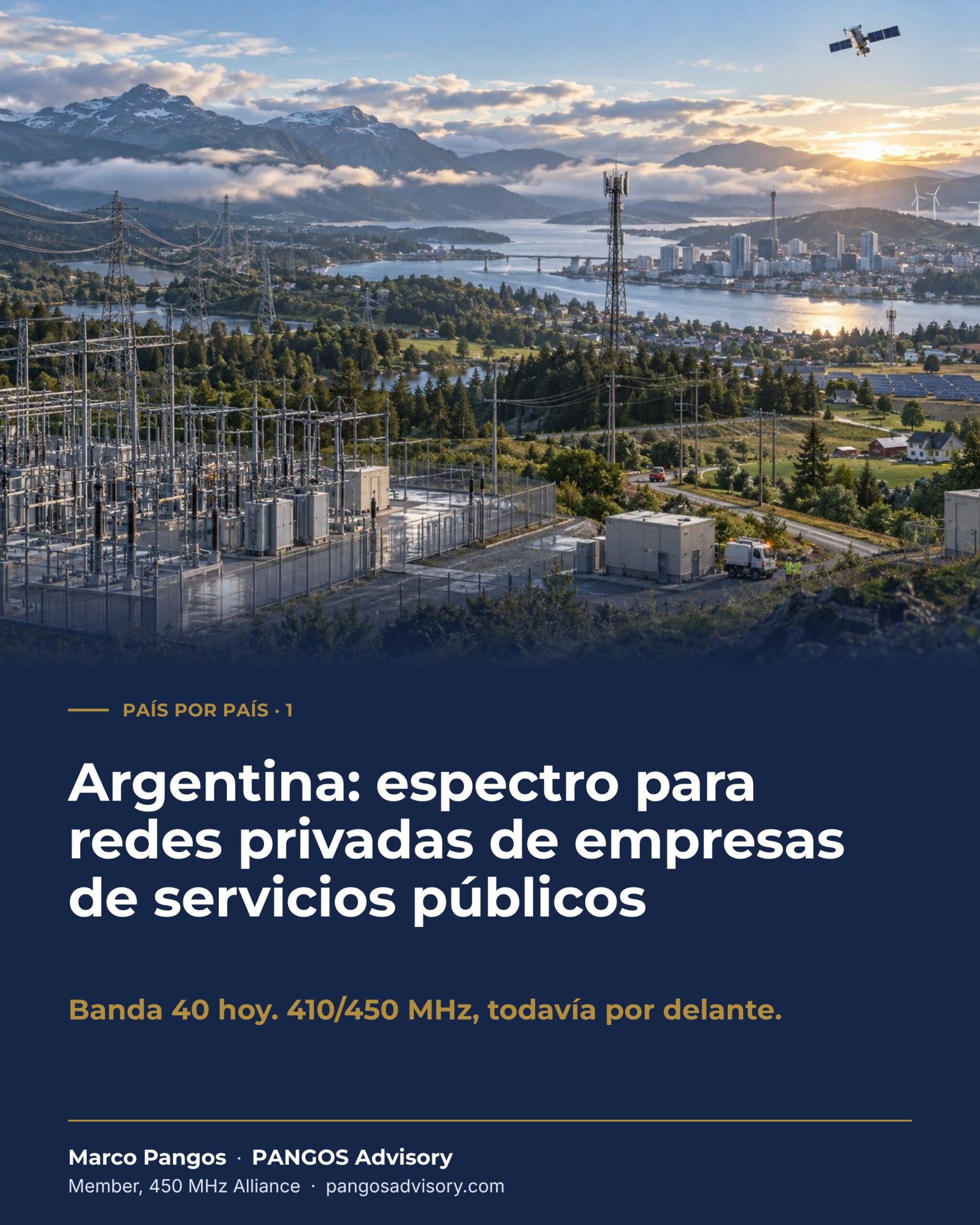

“In Argentina, utilities can currently build private LTE networks only in Band 40; 450 MHz is still geared toward rural ICT providers. Our member, PANGOS Advisory, maps the rules and explains what utilities need to demonstrate to the regulator to change that.”
I promised to go country by country. I’m starting with Argentina.
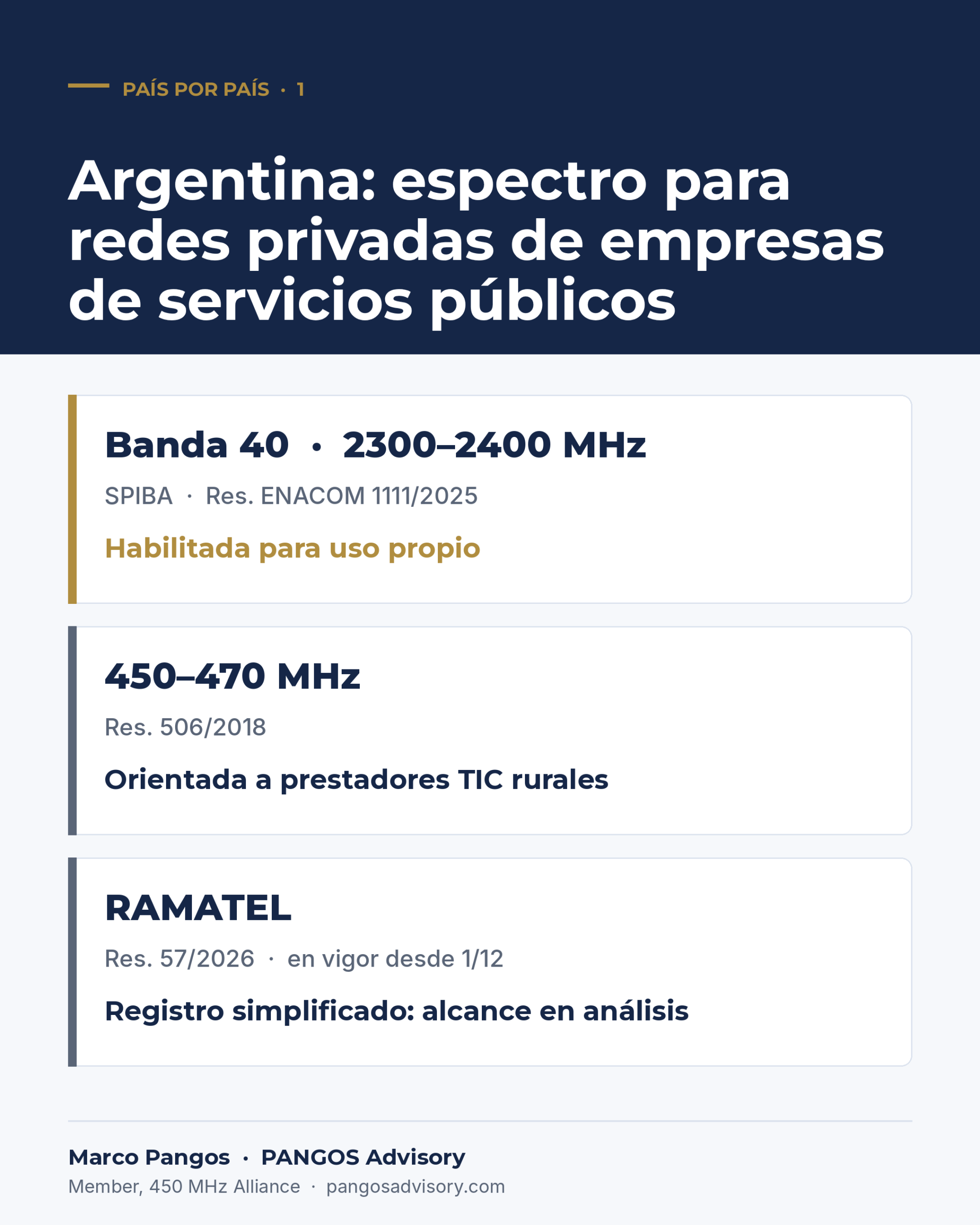
Today, an Argentine utility that wants its own private LTE network has a clear path: the SPIBA regime (ENACOM Res. 1111/2025) enables private networks for own use, but in 2300–2400 MHz, Band 40, with channels of up to 10 MHz.
It works. But for an electricity grid it is a demanding band: more sites for the same coverage, and less penetration into substations, underground vaults and rural areas. In a comparison presented at a regional industry forum, covering the same area at 2.3 GHz required, in that scenario, 12 to 15 times more base stations than at 410 MHz.
And 450 MHz? The 450–470 MHz band (Res. 506/2018) is oriented to rural ICT service providers, with 20 MHz per area in localities of fewer than 100,000 inhabitants. In the published rules, I don’t see a direct path today for a utility’s own operational network.
The interesting part is that things are moving. The new RAMATEL regime (Res. 57/2026), which after an extension enters into force on 1 December 2026, simplifies the registration of end-user equipment. We are verifying how far it goes.
One fact adds urgency. Distributed generation is still small in the country, but batteries are not: Argentina has already awarded about 1,400 MW of storage in two tenders, the first at critical nodes in the metropolitan area, with contracts signed by the electricity distributors. Batteries that respond in seconds need a network the utility itself controls.
For manufacturers, the reading is practical: in Argentina today you enter with Band 40, and whoever also has 450 MHz in the portfolio arrives prepared for when the rule changes. For utilities, the question is different: what do they need to show the regulator so that 450 MHz also becomes an option for them? Data like that announced a few days ago by a Brazilian electricity distributor: in the rainy season, the connectivity of its distribution equipment over public networks fell from about 90% to 60%; with its own 450 MHz network, it reports 99%.
A caution against a hasty conclusion. In Atacama, a large copper mine runs private LTE in Band 40 alongside its TETRA radio. It works because it is a bounded site, covered by a few compact base stations. An electricity distributor means thousands of kilometers of network and rural areas: there, Band 40 can serve as a bridge, adding data to the TETRA voice that some distributors in Buenos Aires already use.
That is our work: bringing the experience of countries that have already solved this. If you’re working on this in Argentina, send me a message.
In Argentina, Band 40 is already there; 410/450 MHz is won with arguments before the regulator.
Share this with whoever handles spectrum in your company.